Wukuai Pavilion
Taiwan · Kinmen County · Jinhu Township · Historic Sites
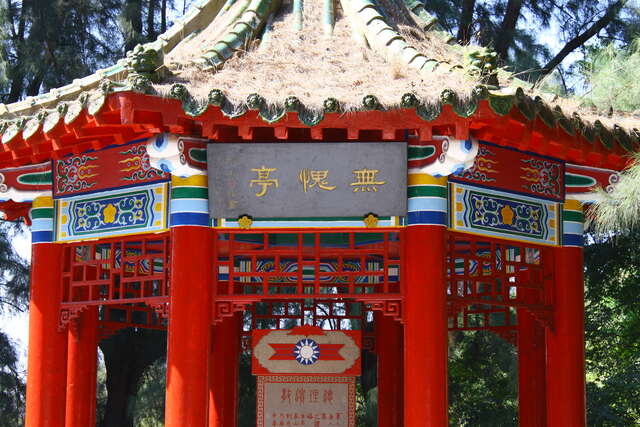
Image source: Taiwan_Opendata; license credits as shown.
Overview
Wukuai Pavilion is a hexagonal pavilion with blue-glazed tiles and red columns located beside the road between Mount Taiwu and the Lu Wang Tomb. The pavilion was named to remind soldiers to follow the spirit of Wen Tianxiang and to be a person who has no shame before heaven, earth, or their parents, and who stands upright with integrity. A marble stele stands inside the pavilion: the front is engraved with Sun Yat-sen’s admonition on “military spirit education,” as written by Zong Xiaochen, while the back bears Wen Tianxiang’s self-admonishing words, as written by Zhang Mojun, explaining the meaning behind the pavilion’s name.
Highlights
Wukuai Pavilion is a hexagonal pavilion that symbolizes soldiers’ discipline and national integrity. It stands beside the mountain road between Kinmen’s Mount Taiwu and the Lu Wang Tomb, offering visitors a place to rest while experiencing the spirit of military service and loyalty. Its name conveys the idea of being “without shame before heaven, earth, or one’s parents,” encouraging soldiers to emulate Wen Tianxiang’s steadfastness and become upright people with nothing to regret. The pavilion’s blue-glazed roof and red columns make it highly distinctive, and it serves as both a memorial and a scenic rest stop, making it a worthwhile short pause on a visit along the Mount Taiwu route. In the center stands a marble stele with Sun Yat-sen’s “military spirit education” inscription on one side and Wen Tianxiang’s self-reflective verse on the other, creating a strong historical atmosphere. Nearby attractions such as the Mount Taiwu hiking trail and the Lu Wang Tomb can be linked into a short journey combining nature, ecology, and wartime heritage.
What to See
1. The hexagonal pavilion itself: Wukuai Pavilion is a hexagonal pavilion with blue-glazed tiles and red columns, surrounded by railings and designed with an elegant form. It stands out prominently at a bend in the mountain road and is a suitable place to rest, take photos, and enjoy the view on the way up Mount Taiwu. Its vivid colors contrast sharply with the green mountain landscape, reflecting the commemorative style of wartime-era architecture. 2. The marble stele and calligraphy inscriptions: A marble stele stands in the center of the pavilion. The front is engraved with an important admonition by Sun Yat-sen on “military spirit education,” while the back bears Wen Tianxiang’s self-encouraging words: “Confucius said to achieve benevolence, Mencius said to choose righteousness; when righteousness is fully fulfilled, benevolence is attained. Having read the books of the sages, what have I learned? From this day onward, I may perhaps be without shame.” The inscriptions were written by renowned calligraphers, allowing visitors to appreciate the stone carving and calligraphy up close while reflecting on the spirit of loyalty and righteousness. 3. The meaning of the name and its military spirit: The name “Wukuai Pavilion” was chosen by senior military officers at the time to remind soldiers to uphold loyalty and filial piety, to live without shame before heaven, earth, their parents, and their country, and to become part of Mount Taiwu’s military and spiritual landscape. Visitors who stop here can not only learn about Kinmen’s past as a frontline battlefield but also feel the emphasis once placed on soldiers’ character and integrity. 4. The scenery along the Mount Taiwu and Lu Wang Tomb route: Wukuai Pavilion is located beside the road between Mount Taiwu and the Lu Wang Tomb. Surrounded by trees and mountain breezes, it offers an open view and serves as an intermediate stop when linking the Mount Taiwu trail, the Lu Wang Tomb, and other wartime sites. Travelers can plan a walking or driving route between the Lu Wang Tomb, the Sun Yat-sen statue on Mount Taiwu, the Martyrs’ Shrine, and other nearby attractions to experience Kinmen’s mountain scenery and layered historical stories.
Address
No. 5, Section 5, Boyu Road, Jinhu Township, Kinmen County 891 Tel: (08)2313100
Travel Tips
The best way to visit Wukuai Pavilion is to include it in a half-day or full-day itinerary around Mount Taiwu, together with the Lu Wang Tomb, the Mount Taiwu trail, and nearby wartime attractions. It is a good place to pause for photos and to read the inscriptions at a relaxed pace. Autumn, winter, and spring are more comfortable and offer better visibility, making them the best seasons for walking in the mountain area; summer sunlight is strong, so bring a hat, sunscreen, and plenty of water. Since the pavilion sits beside a bend in the mountain road, drivers and motorcyclists should slow down, stay alert, and look for safe parking before getting out. If you go on foot, follow the Mount Taiwu health trail and route signs, and adjust the length of your walk according to your fitness level. The pavilion is an open-air structure, so be careful of slippery ground during rain or strong wind; mosquitoes may also be present, so insect repellent is recommended. When visiting, simply read the inscriptions and take photos; do not climb the railings or scratch or graffiti the stone inscriptions.
FAQ
Q: How do I get to Wukuai Pavilion? A: Wukuai Pavilion is located beside the mountain road between Mount Taiwu and the Lu Wang Tomb in Kinmen. Most travelers get there by car, scooter, or on foot via the hiking trail. If you follow the road toward Mount Taiwu, you will see the pavilion with its red columns and blue-glazed tiles shortly after passing the Lu Wang Tomb; it is very noticeable. If you are hiking, you can follow the Mount Taiwu health trail uphill and stop at the pavilion when the signs indicate it. Q: Is there an admission fee or opening-hours restriction for Wukuai Pavilion? A: Wukuai Pavilion is an open-air pavilion beside the road and is generally open for free visits at any time of day. It is not a separately ticketed attraction but a spiritual landmark along the Mount Taiwu route, so most visitors stop by while passing Mount Taiwu or visiting the Lu Wang Tomb. However, the area becomes darker after dusk, so visiting during daylight is safer and more convenient. Q: What is the historical and spiritual significance of Wukuai Pavilion? A: The pavilion was named to encourage soldiers to emulate the spirit of Wen Tianxiang and to live without shame before heaven, earth, and their parents. For that reason, a marble stele inside the pavilion bears Sun Yat-sen’s “military spirit education” inscription and Wen Tianxiang’s self-admonishing verse. These inscriptions and calligraphic works reflect the wartime emphasis on soldiers’ character, loyalty, righteousness, and self-sacrifice, making Wukuai Pavilion more than just a resting place; it is also a historical memory and spiritual symbol of Kinmen’s frontline past. Q: How long should I stay at Wukuai Pavilion, and what kind of trip is it suitable for? A: The pavilion is small and is mainly for viewing the architecture, reading the inscriptions, and taking a short rest. Most visitors stay for about 10 to 30 minutes. The best way to include it is as a stop along a Mount Taiwu route, together with the Lu Wang Tomb, the Mount Taiwu trail, and nearby wartime sites. It is especially suitable for travelers who enjoy light hiking, history, culture, and photography, and it works well as part of a half-day or full-day trip.