Qiu Liang-gong Tomb Garden
Taiwan · Kinmen County · Jinhu Township · Historic Sites
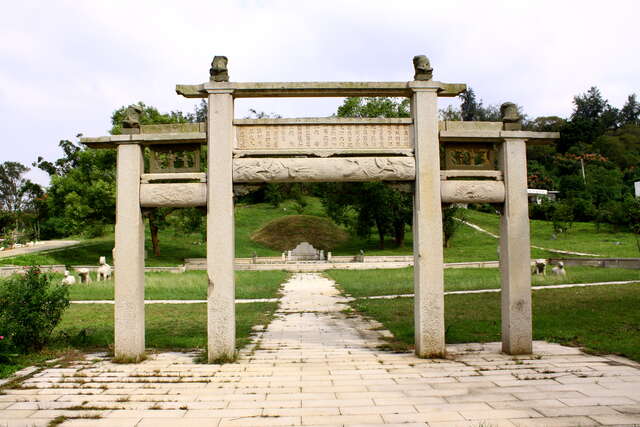
Image source: Taiwan_Opendata; license credits as shown.
Overview
Qiu Liang-gong Tomb Garden is the burial mound of Qiu Liang-gong, a Qing-dynasty baron of the third rank, located in Xiaojing Village, Jinhu Township, Kinmen County today. It was designated by the Ministry of the Interior as a third-class historic site in the Taiwan-Fujian region.
Highlights
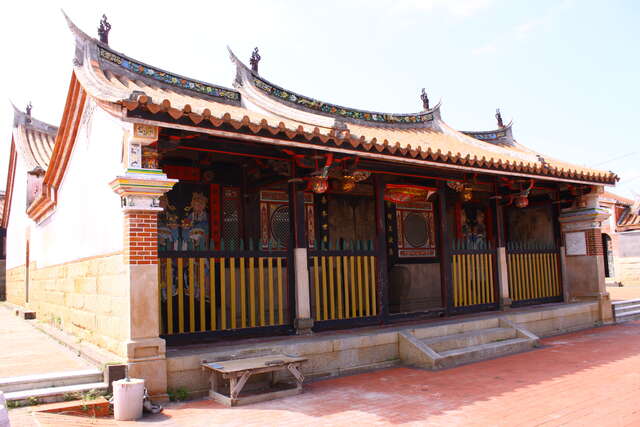
Qiu Liang-gong Tomb Garden is a well-preserved general’s tomb complex built according to Qing-dynasty ritual standards, and it is one of Kinmen’s important cultural attractions for seeing ancient tomb architecture and learning about a famed coastal defense commander. The tomb belongs to Qiu Liang-gong, who was posthumously granted the title of third-rank baron and later served as Admiralty Commander. It stands in Xiaojing Village, Jinhu Township, and was listed early on as a third-class historic site in the Taiwan-Fujian region; it is now a county-level historic site. Facing south with its back to the hills and front toward water, the complex features a grand stone tomb archway, rows of stone beasts, and stone civil servants, displaying the scale of an elite Qing burial site. It is also one of the most completely preserved ancient tomb gardens in the Taiwan, Penghu, Kinmen, and Matsu area.
What to See
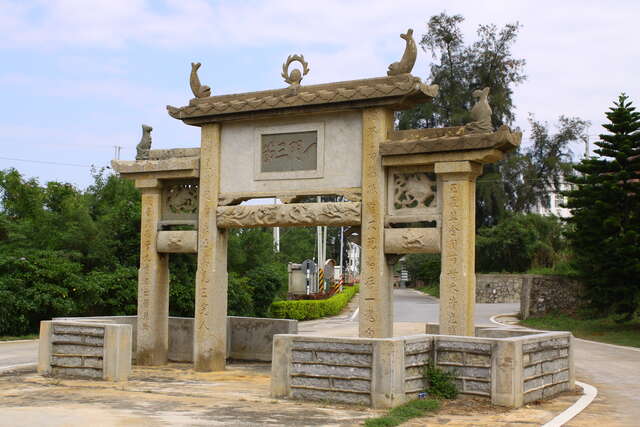
1. Stone tomb archway and axial layout: The stone tomb archway is a granite structure with four pillars, three bays, and two tiers, positioned directly in front of the burial mound and serving as the most striking visual focus on arrival. From the memorial archway and stele pavilions to the watch pillars, stone animals, and finally the mound itself, the complex unfolds along a central axis in layered sequence, fully showing the layout of an official Qing burial site. It is ideal for close viewing of the carving details and proportions of each element. 2. Twin stele pavilions and imperial inscriptions: There is a symmetrical stele pavilion on each side of the archway, housing a spirit-road stele and related inscriptions that record Qiu Liang-gong’s achievements. Some inscriptions were ordered by the Jiaqing Emperor to honor his military merits and virtue. Visitors can look closely at the text and calligraphy to appreciate the court’s recognition of this coastal defense hero. 3. Stone sheep, stone tigers, stone horses, and stone civil servants: On both sides of the tomb path, stone beasts are arranged from the outside inward in the order of stone sheep, stone tigers, and stone horses, followed further inside by stone civil servants dressed in official robes. These figures symbolize protection and ritual rank. This complete set of stone attendants is well preserved, with fine workmanship, making it a key highlight for photography and for observing Qing-dynasty stone carving art. 4. The tomb mound and the terrain of hills behind and water in front: At the innermost part of the complex is Qiu Liang-gong’s tomb mound, built to fit the hillside and backed by a small rise near Mount Taiwu, with an open view in front. This reflects the traditional feng shui pattern of hills behind and water in front. Standing before the mound and looking back toward the archway and Xiaojing settlement, visitors can feel the spatial relationship between the tomb and the surrounding landscape. 5. The atmosphere around Xiaojing settlement: Qiu Liang-gong Tomb Garden sits at the edge of Xiaojing Village, where the lanes still retain the appearance of a traditional settlement. Nearby attractions such as the Special Agreement Teahouse Exhibition Hall can be visited together on a walk, allowing visitors to experience both wartime memories and the distinctive atmosphere of a traditional village.
Address
No. 891, Xiaojing Village, near Mount Taiwu, Jinhu Township, Kinmen County Phone: (08) 2328638
Travel Tips
The best way to visit Qiu Liang-gong Tomb Garden is to combine it with an itinerary around Jinhu or Mount Taiwu, making it one stop on a half-day or full-day cultural and historical route. It is recommended to park first near the Special Agreement Teahouse Exhibition Hall or around Xiaojing settlement, then follow the signs and walk in; the route is clear and the slope is gentle, making it suitable for most visitors. Spring and autumn in Kinmen are the most comfortable seasons for visiting, with milder temperatures for reading inscriptions and appreciating the stone carvings. In summer, the sun can be intense, so hats, sunscreen, and drinking water are recommended. In winter, the northeast monsoon can be strong, so warm clothing is advisable. The site has many stone floors and stairs, so non-slip shoes with good traction are recommended, especially after rain. As a commemorative burial monument, the site should be visited quietly. Avoid loud voices, running, or climbing on the stone carvings, stele pavilions, or tomb mound so as to protect the cultural asset and maintain basic etiquette. If you are interested in Qing-dynasty military history and Kinmen history, it helps to read a little about Qiu Liang-gong’s role in suppressing pirates and defending the maritime frontier before visiting, since this will make the inscriptions and architectural layout more meaningful. By bus, take a route from Jincheng Bus Station to the Xiaojing or Xiaojing No. 1 stop and then walk in following the signs. By car, follow Taihu Road and Boyu Road and enter Xiaojing Village according to the signs; the roads are generally stable, but village lanes are narrow, so drivers should be careful of oncoming traffic and pedestrians.
Nearby Dining
Although Xiaojing Village is not a busy commercial area, there are still a few local snack shops and convenience stores nearby for simple meals and supplies, offering a more down-to-earth village atmosphere. For a wider range of dining options, return to the Jinhu Township center or the Shanwai area, where Kinmen’s common noodle shops, seafood places, and snack stores are concentrated, making them suitable for main meals and dinner before or after visiting the tomb garden and nearby attractions.
FAQ
Q: What is the main thing to see at Qiu Liang-gong Tomb Garden? A: The main appeal of Qiu Liang-gong Tomb Garden is its complete presentation of the layout of a high-ranking Qing military official’s tomb and its stone-carving art, including the grand stone tomb archway, symmetrical stele pavilions, rows of stone beasts, stone civil servants, and the tomb mound itself set against hills with water in front. Visitors can walk along the central axis to view the archway, stele pavilions, stone attendants, and tomb mound in sequence, while reading the inscriptions to learn about Qiu Liang-gong’s historical achievements in suppressing pirates and defending the sea frontier during the Jiaqing reign. Q: Who was Qiu Liang-gong, and why does he have such a large tomb garden in Kinmen? A: Qiu Liang-gong was a Kinmen-born Qing-dynasty commander who earned merit in suppressing coastal pirates during the Jiaqing reign, later rising to the post of Zhejiang Admiralty Commander. He was posthumously granted the title of third-rank baron and buried by imperial order, which led to the construction of a large tomb garden in his hometown that matched the ritual standards for high-ranking military officials. His courtesy name was Yuyun and his studio name was Zhuozhai; he was from Houpu in Kinmen, born in 1769 and died in 1817 at the age of forty-nine. His tomb garden has also become an important place in Kinmen for commemorating a local hero and studying Qing-dynasty coastal defense history. Q: How do you get to Qiu Liang-gong Tomb Garden, and is it better to drive or take the bus? A: Qiu Liang-gong Tomb Garden is located near Xiaojing Village, Jinhu Township, Kinmen County. You can drive there along the main roads and follow the signs, or take a bus from Jincheng Bus Station and get off at the Xiaojing or Xiaojing No. 1 stop, then walk the rest of the way. A common driving route is from the Shanwai area along Section 1 of Taihu Road, then onto Section 5 of Boyu Road toward Xiaojing; signs are posted along the way. If using public transportation, routes such as Red 1, Blue 1, Blue 2, or 1A can be used, and after getting off at the relevant Xiaojing stop, simply follow the signs into the settlement. Q: Are there etiquette rules or restrictions when visiting Qiu Liang-gong Tomb Garden? A: Qiu Liang-gong Tomb Garden is a county-level historic site and a burial space with a ritual function, so visitors should keep quiet, avoid noise and chasing around, and not climb or touch the stone carvings or inscriptions in order to protect the cultural asset and respect the deceased. Light, modest clothing is recommended, and drinking alcohol or engaging in recreational activities in the tomb area should be avoided. Treat the site as a place of history and remembrance, and focus on appreciating the architecture and inscriptions.