Huxia Sanjian Louzi
Taiwan · Kinmen County · Jinning Township · Historic Sites
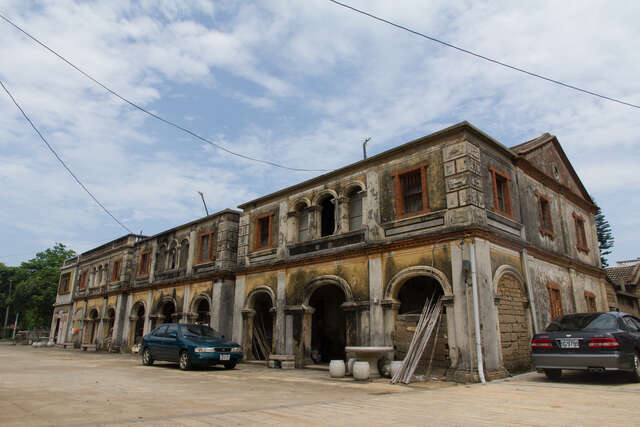
Image source: Taiwan_Opendata; license credits as shown.
Overview
In 1945, the Jinhefa Company on Huxia Paizai Road operated an oil mill and commercial shipping, managed by Yang Hongli, Yang Qingyan, and Yang Yingju. They transported goods between Zhangzhou and Shima in Fujian, and then brought bamboo products and wood back to Kinmen for sale. After becoming wealthy, they built three Western-style buildings, each sharing one unit.
Highlights
Huxia Sanjian Louzi is a historical architectural complex consisting of three adjacent Western-style buildings with five-foot foundations located in Hupu Village, Jinning Township, Kinmen County. It showcases the prosperity of pre-war commerce and the architectural style of overseas Chinese communities. Built around the 34th year of the Republic of China, these buildings were constructed collaboratively by the three Yang brothers who became wealthy from the oil mill and shipping business, each receiving one building. The structures are lined up in a row near Cihu, creating a distinctive settlement landscape. Architectural details such as arcades, pebble-washed corners, and round windows on gable walls, along with inscriptions like "Qingbai Shizhou" and "Hongnong Yanpai," represent a key scene for understanding the aesthetics of Kinmen's merchant families and architecture.
What to See
1. Three Adjacent Western-style Buildings The three buildings are aligned in a row with harmonious proportions, forming a remarkably complete architectural group in the Huxia settlement, creating a continuous streetscape that is perfect for photography from the front and at an angle. 2. Arcade and Five-foot Foundation The building facade features brick-constructed arcades, combined with the five-foot foundation space, showcasing an early blend of practicality and aesthetics in street house facades. Walking under the arcade allows for close observation of the column segmentation lines and detailed decorations. 3. Inscriptions "Qingbai Shizhou" and "Hongnong Yanpai" Two of the buildings have inscriptions "Qingbai Shizhou" (No. 44) and "Hongnong Yanpai" (No. 45) on the second-floor arcade, symbolizing the Yang family's lineage and family values, making it an important detail for close-up photography and understanding clan culture. 4. Round Vent Windows and Pebble-washed Corners The gable walls of the buildings feature round vent windows, and the corners are decorated with pebble-washed materials, giving the architecture a Western-style flavor amidst the plain brick walls, making it a good example for observing Kinmen's mixed architectural vocabulary. 5. Current Condition and Historical Traces The three buildings serve as residences, warehouses, or are currently idle, showing signs of moisture on the exterior walls and wooden structures, along with stairs and windows that were repaired after being bombed during the war, adding a layer of wartime memory to the overall space. 6. Huxia Settlement and Surrounding Walking Environment The Huxia settlement is near Cihu and can connect to nearby ancient houses, settlement alleys, and ecological art walls, making it a suitable walking route with a small range, perfect for a leisurely stroll in Jinning Township.
Address
No. 44, 45, 46 Huxia, Hupu Village, Jinning Township, Kinmen County 892 Phone: (08) 2318823
Travel Tips
Huxia Sanjian Louzi can be visited year-round, and it is usually recommended to arrange it alongside a trip to Jinning Township and the Cihu area, with a stay of about half an hour to an hour for leisurely photography and walking. 1. Visiting Time and Lighting Morning and afternoon light is softer, creating distinct shadow layers on the building facade, making it more suitable for photography; on sunny days, the orange roof tiles and wall colors stand out more, so travelers who enjoy architectural photography may want to avoid the strong midday backlight. 2. Transportation Suggestions Most travelers will arrive by scooter or rental car, connecting to other attractions in Jincheng and Jinning; if taking the bus, it is advisable to check the schedule and the nearest bus stop before arranging walking time. 3. Visiting Etiquette Some buildings are still private residences or storage spaces, so it is recommended to only take photos in the outer and public areas, avoiding unauthorized entry into homes or photographing residents' privacy, maintaining quietness and not disturbing local residents' daily lives. 4. Safety and Walking The ground around old buildings may be uneven and can become slippery after rain, so it is advisable to wear comfortable flat shoes and be cautious of stairs and corners; do not climb walls or old structures to avoid endangering yourself and the buildings. 5. Combine with Nearby Attractions You can arrange Huxia Sanjian Louzi with other ancient houses in the Huxia settlement, the Huxia ecological art wall, and nearby attractions along the same walking or driving route to enrich your itinerary. 6. Photography Tips It is recommended to compose shots from a medium to long distance to capture the complete streetscape of the three adjacent buildings, and then take close-ups of the inscriptions, round vent windows, and arcade details; if you happen to capture residents in your photos, consider cropping them before posting to respect their privacy.
FAQ
Q: What are the main features of Huxia Sanjian Louzi worth seeing? A: The features of Huxia Sanjian Louzi include the three buildings lined up in a row, preserving the complete facade of the five-foot foundation Western-style buildings and clan inscriptions, showcasing the settlement style of Western-style buildings built by wealthy Kinmen merchants. Travelers can enjoy the continuous arcades and pebble-washed corners from the street front, observing the round vent windows and details of inscriptions like "Qingbai Shizhou" and "Hongnong Yanpai," making it a great spot for combining architectural beauty with local family stories. Q: Is there an entrance fee or specific opening hours to visit Huxia Sanjian Louzi? A: Huxia Sanjian Louzi is located in an open street area and can be freely visited. Most travelers stop by while passing through, walking, or taking photos. The site is a historical building and a living space, not a typical paid attraction. If you need to enter specific buildings or participate in guided activities, you can check local announcements or inquire with relevant units for the latest arrangements. Q: Can visitors enter the buildings at Huxia Sanjian Louzi? A: Some of the buildings at Huxia Sanjian Louzi are still used as residences or warehouses, so the focus is on viewing and photographing from the external public areas, and they are generally not open for casual entry. It is advisable to respect residents and private spaces; if you encounter local residents or guided activities, you may approach for close viewing after obtaining consent, and avoid touching old materials. Q: How much time should be allocated for visiting Huxia Sanjian Louzi, and how should the itinerary be planned? A: A visit to Huxia Sanjian Louzi typically takes about 0.5 to 1 hour for leisurely photography and walking. It is usually planned alongside attractions in Jinning and Cihu for a half-day or full-day trip. It is recommended to drive or ride a scooter to connect with other ancient house settlements, wartime sites, and natural landscapes. If taking the bus, check the schedule in advance and allow walking time to avoid a tight itinerary.